
S: For I shall consider the cover – without, of course, judging the book by it. This volume before me, rescued from heap in a shambles of a shop on the Isle of Skye: New York: The Viking Press, 1945, 4th printing, first American edition, with 28-page appendix listing author’s corrections; fair to good condition, black cloth cover, some rubbing, sunned; title in gold, all caps, FINNEGANS WAKE.
Only when it was published, on Thursday May 4 1939, was this title revealed by the author. Theretofore, it had been known as a “Work in Progress.”
M: And so I will consider these two covers before me, both paperbacks; one a Penguin Twentieth-Century Classic; the other from Minerva Press, still presumably considered classic. The first, according to its receipt-now-bookmark, faded and, somewhat appropriately unreadable in its own way, was purchased 1/18/00, no doubt the product of a zealous optimism, the result of New Year’s resolutions raised to a power of ten by the fact that the world had not ended two-and-a-half weeks earlier. My Nora rescued the second copy from our building’s laundry room lending library, where it rubbed spines with both Tristram Shandy and Fifty Shades of Grey.
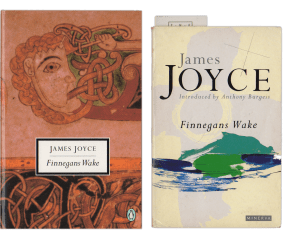 Each paperback suspiciously uses what I take to be Eric Gill’s Perpetua for the title. (Since we are speaking to etymology and origin in this post, and since we two posters — as well as Mr. Joyce — are of decidedly Catholic lineage, it is worth noting that Perpetua was a third-century Christian martyr, thrown to the beasts of the arena at the tender age of 22.) Designed c. 1925-9, Pereptua’s transitional italic has its ‘classic’ qualities and is not a bad choice at all. Of course, for the Penguin edition, it’s part of a series, and therefore equally ‘appropriate’ for my copies of Gravity’s Rainbow and Been Down So Long It Looks Like Up to Me.
The surname Finnegan is an Anglicized form of Fionnagán, a diminutive of Fionn (white, fair, bright): hence, it means, approximately, “little blondie.” At present, the name is most common in counties Cavan and Moneghan. Finnegans have not been prominent in the cultural or political history of Ireland, but Fionn mac Cumhail is a legendary Irish hero, captain of the Fianna of Erinn, giant slayer, trickster, thumb-sucker and cuckold. His birth name was Deimne, but he was known as Fionn for his yellow hair – as we learn from the finnaiocht, the body of tales about him, known as the Fenian Cycle. We may assume that Fionn mac Cumhail, a/k/a Finn MacCool, will make an appearance in the text.
Upon closer examination of the Minerva, there’s some not-so-tight kerning in the always troubling ‘Wa’ pair. It happens, especially under deadline. It would be hard to automatically fault the credited designer, Angus Hyland, now a partner at Pentagram’s London offices, where he gets credit for their venerated Books of the Bible and Pocket Canons series. More recently, he and his team crafted a lovely series of Nabokov redesigns, which — viewed only via photos on the web — appears to use, yes, Perpetua, paired with Gill’s other classic: Gill Sans, which is even used selectively on this very site. Always we go in circles.
Hyland went for abstraction, reminiscent of his later covers for the catalog of an author whose name I am pretty sure we are not allowed to mention on this site. (Hint: State Animal) As noted in eye magazine, his “Striking abstract images replaced the hackneyed Dublin street scenes used for James Joyce.” A more than fair point, especially in 1992. The Penguin, template-based as it is, also relies on imagery; a page from The Book of Kells. A bit safe, but appropriate in the carnival of serifs and sans that emerge from the mouth of its Celt.
An even earlier figure to bear the name of Finn was Emhear Fionn mac Miled, a/k/a Éber Finn. According to the Lebor Gabála Érenn, “The Book of the Taking of Ireland,” Éber was among the Milesians, i.e. the Gaels, who invaded Ireland in the distant past. Through the wisdom and magic of their master-poet Amairgen, the sons of Míl gained the support of Ireland’s three goddess-queens, defeated the Tuath Dé Danaan at the Battle of Tailltiu and banished them to live underground. Amairgen then divided the island between Éremón, who ruled the northern half, and his younger brother Éber Finn, who ruled the south. Of course, being brothers, they quarreled and made war upon each other. Éremón was the victor, and his brother was slain. We might, then, expect sibling rivalry to be a theme in the tale.
Two other Finns we might expect to encounter within: our Huckleberry river-borne friend and Mickey, the bringer of sleep.
“Fin” means “the end,” as in finite, final, finished. To end “egan” – again – implies having begun again, and likely to begin – and end – again, in a sort of in-Fin –ite Fenian Cycle. (Racing handlebars optional).
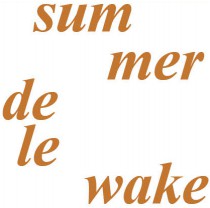
Translating words into imagery is at the heart of modern book cover design, and Joyce’s words are all the more challenging given the wordplay and dream imagery that define the Wake. It’s more a hope than a criticism of either cover to ponder a purely typographic version, expressive in the extreme, that places the emphasis where Joyce did, on the words and the possibility inherent in them as the purest form of abstraction. Gill wrote that “The shapes of letters do not derive their beauty from any sensual or sentimental reminiscence. No one can say that the o’s roundness appeals to us only because it is like that of an apple or of a girl’s breast or of the full moon.… Letters are things, not pictures of things.” Yet they are capable of summoning all things, which I propose is nowhere more true than in Finnegans Wake.
Now that we have both paused reverentially and referentially at the cover, it might be time to dive in. After all, the Penguin cover does label it is a ‘classic,’ and classics must be read.
(p. s. Nora Barnacle worked at Finn’s Hotel in Leinster Street, Dublin, when Joyce first met her.)
 sum mer de le wake