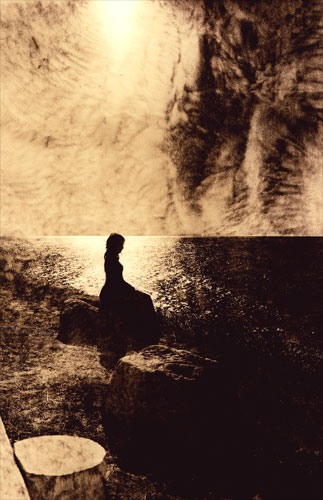
fig. 1 – Summer by Kathleen Creighton
M: Ladies and Gentleman: Anna. Livia. Plurabelle!
She is ALP to Earwicker’s HCE; not a mountain, but a river, one aitch removed from ALPH, the “sacred river” of Coleridge’s “Kubla Khan,” then another a-pex from ALPHA, the start of the Greek ALPHABET, a natural complement to the eponymous FIN-again. And if you don’t think Joyce was thinking all these things (and many more), then you haven’t been paying attention.
Like many a river, she occasionally overspills her banks. She takes center stage in Chapter 5 but has been hinted at and now is properly introduced in the last pages of Chapter 4, with the parenthetical playing up and down of her and Humphrey’s initials. “(En caecos harauspices! Annos longos patimur!)” FW 100.18. (With allowance for Joyce’s usual creative spelling, Google translate takes us to: “And blindly soothsayers! Long years of suffering!” Oh boy…)
Half a page later, in the wake of the trial of the Wake, we are told “Dispersal women wondered. Was she fast?”
And we’re off. With a series of lines that will sound vaguely familiar to those who have tried reading what is billed as the “most accessible” chapter of Finnegans Wake (Chapter 8; FW 196): “Do tell us all about. As we want to hear all about. So tellus tellas allabouter.” FW 101.2-3. Joyce keeps retelling his stories, producing a sense of déjà vu and presciedents that fill our dreams as well.
Anna seems a good wife to HCE. She “shuttered him from his fall and waked him widowt sparing.” Now she’s beside her besieged husband “to crush the slander’s head.”
The brief introduction ends: “For we, we have taken our sheet upon her stones where we have hanged our hearts in her trees; and we list, as she bibs us, by the waters of babalong.” FW 103.10-12
Look to Psalm 137: “Sorrow and Hope in Exile”:
By the rivers of Babylon
we sat mourning and weeping
when we remembered Zion.
Mourning? Weeping? Remembering? Sounds like a wake.
This is also the Psalm that says; “On the poplars [aka trees] of that land we hung up our harps” and — mind you — ends with:
Happy those who seize your children
and smash them against a rock.
Or a stone, perhaps.
Stones and trees will play an important role (stem and stone; shem and shaun) in the same upcoming ALPcentric chapter 8 mentioned above, but we’ve already seen the babbling waters back at the first hundred-letter word on page 3: “bababadal…” (followed by variants on “thunder” in various languages). An ode to the Tower of Babel (Genesis; Chapter 11.) and the dispersal of language that makes Finnegans Wake possible.
Now forty pages back, before we were properly introduced: “the young reine came down desperate and the old liffopotamus started ploring all over the plains, as mud as she cud be, ruinating all the bouchers’ schurts and the backers’ wischandtugs so that be the chandeleure of the Rejaneyjailey they were all night wasching the walters of, the weltering walters off. Whyte.” FW 64, 16-21
There’s our Anna — really with us since “riverrun” — overflowing her banks, and dirtying the whites, which must be washed on rocks, and hung on trees.
Clear as Liffeywater.
 sum mer de le wake